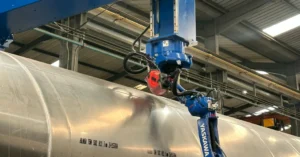
A highly specialised robotic welding solution developed by Yaskawa Southern Africa is helping Tank Clinic transform the way it manufactures aluminium road tankers. The system, developed specifically around Tank Clinic’s requirements, combines a Yaskawa AR1440 welding robot with an OTG-XYZ on-track gantry, rotating headstocks, positioners, vision-based seam finding and aluminium welding technology.
The result is a large-scale robotic welding system capable of moving around the tanker while the tanker itself rotates, providing the reach, accessibility and welding positioning required for the final welding process.
Skilled welders
The project originated from Tank Clinic’s need to improve the capacity, consistency and repeatability of a welding process that had previously been carried out exclusively by skilled welders. Rather than applying an off-the-shelf robotic cell, Yaskawa worked with Tank Clinic to develop a system around the size, geometry and production requirements of its tankers.
“Large aluminium tankers present a very different challenge from the smaller, repetitive applications with which robotics are traditionally associated. The robot needs to reach across a large workpiece, maintain the correct welding orientation and coordinate its movement with the movement of the tanker itself,” says Devon Prinsloo, National Project Manager at Yaskawa Southern Africa.
One coordinated system
“The solution therefore required considerably more than putting a robot on a track. It involved integrating the robot, gantry, positioners, welding equipment and vision system so that they operate as one coordinated system.”
A conventional fixed robot would have significant limitations when working across a tanker of this scale. The OTG-XYZ gantry provides approximately eight metres of track travel, with additional multi-axis movement, while two headstocks rotate and position the tanker for welding.
Various technologies
The system also incorporates Fronius Cold Metal Transfer (CMT) technology for aluminium welding and a Servo Robot i-Cube camera system for seam finding, alongside automatic torch cleaning and safety systems.
Significant engineering, programming and R&D went into integrating the various technologies to suit Tank Clinic’s specific manufacturing process. The Yaskawa robot controller also serves as the central control system for the entire cell, eliminating the need for a separate PLC (programmable logic controller), which would typically coordinate the different machines and processes within an automated system.
Equally significant
The impact on production is equally significant. Tank Clinic previously averaged approximately one week to fully weld a tanker. The automated system can now complete the welding process within an eight-hour working day, depending on the specific tanker configuration.
Beyond production speed, automation provides consistent welding parameters and programmed movement, reducing dependence on repetitive manual operations while enabling skilled personnel to focus on areas where their expertise adds greater value.
Greater use of workforce
For Tank Clinic, the investment represents an opportunity to combine its 50 years of manufacturing experience with advanced technology designed for its future requirements.
“The significance for us is not simply having a unique piece of equipment. It demonstrates that South African manufacturing can adopt and implement world-class technology for highly specialised applications,” says Steven Holm, Technical Director at Tank Clinic. “The system gives us greater consistency and repeatability, while allowing us to make more efficient use of our skilled workforce.”
First in South Africa
The installation is also significant for Yaskawa globally. It is the first OTG gantry system of this type installed in South Africa and one of four worldwide, highlighting the engineering capability required to apply advanced robotic technology to a complex, large-scale manufacturing environment.
“As manufacturers look to improve productivity, quality and competitiveness, the opportunity is to use automation to solve specific production challenges rather than simply automate for the sake of automation,” Devon concludes. “The Tank Clinic project is a good example of how robotics, engineering and local manufacturing expertise can be brought together to create a solution around a real industrial requirement.”