The Hyperloop is currently still in the testing phase, but its success depends not least on the quality of the vacuum technology. Only in a vacuum tunnel is air resistance low enough to enable energy-saving gliding at speeds of up to 1 000 kilometres per hour through a tube. Vacuum pioneer Leybold is therefore involved in the project, providing advice and support as well as its vacuum pumps.
The cooperation between Leybold and the Eurotube non-profit foundation has proven successful and has grown over the years. EuroTube was founded in 2019 by a group of former students from ETH Zurich and EPF Lausanne in Switzerland who successfully participated in SpaceX Hyperloop Competitions.
It has since developed into a research centre with 15 employees, an office, and a laboratory in Dübendorf near Zurich.
Accelerated development
The partners first met in August 2017 during the SpaceX Hyperloop Pod contest in Hawthorne, California, on SpaceX premises. This was after the ETH Zurich students had beaten thousands of teams with their Swissloop concept. “That’s why we immediately offered our support,” reports Leybold’s Tom Kammermeier enthusiastically.
“Five colleagues immediately travelled from Cologne to Zurich to visit two students in rented university rooms to learn about their visionary ideas,” adds Kammermeier. These ideas were so well-founded that other specialists from Leybold have since joined the project: In addition to Dr. Tom Kammermeier, Sebastian Rosensträter has also been supporting the EuroTube team in a management role.
Framework conditions
Among other things, Leybold regularly performed calculations and simulations for EuroTube during this time because the framework conditions were developing dynamically. The designs therefore had to be repeatedly adjusted and recalculated. The result was positive, because in July 2024, EuroTube was able to celebrate the kick-off of the first construction phase of the Hyperloop test facility “DemoTube” in the Zurich Innovation Park.
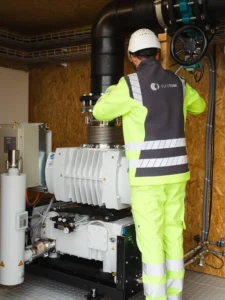
EuroTube currently has a vacuum pump station from Leybold running on this demonstrator, consisting of RUVAC WH4400 series roots pumps and the DRYVAC DV650 dry-compressing screw vacuum pump. “These are typically volumetric pumps that reach down to the fine vacuum range,” explains Tom Kammermeier. The pump stand container also has space for another system so that pumping capacity can be increased further as needed during test operation once completion.
Pump-down time and leak rate
How long and how often evacuation is required, and at which section of the route are the crucial questions that needed to be answered from a technological perspective. “And that is precisely the input that we were able to provide. There are two important variables here,” Tom Kammermeier explains: the pump-down time and the leak rate.
The pumping time determines how quickly a Hyperloop can resume operation after the tube has been ventilated, and the leak rate determines how many pumps of what size need to be running in order to maintain the operating pressure. Various pressure gradients can then influence the exact positioning and distribution of the suction capacity along the route. “However, this only really becomes relevant for large dimensions that have not yet been realized today,” adds Tom.
The two big players, Virgin Hyperloop One, owned by investor Richard Branson, and Hyperloop Transportation Technologies (HTT), have already ordered pumping systems consisting of up to eight DRYVAC and eight WH Roots pumps from Leybold. In addition, the HTT system has been designed in a container so that the vacuum technology can then be offered as a mobile solution.