Mission-critical HVAC Solutions
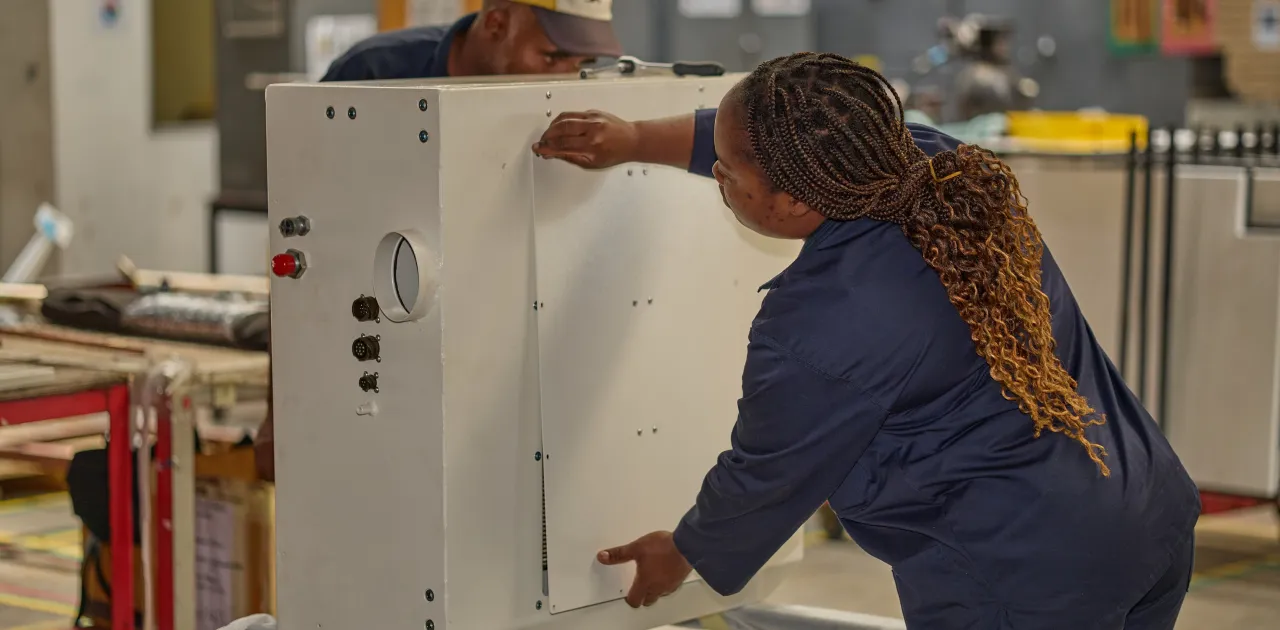
Among Booyco Engineering’s recent projects has been the design and manufacture of complex cooling systems for radar jamming shelters as well as for leading edge military amphibious vehicles. According to Grant Miller, Executive Director at Booyco Engineering, “We engineer our systems to suit the particular demands of complicated military equipment, designed for the harshest conditions while still meeting onerous specifications.”
In one recent project, these custom engineered solutions are being fitted to specialised hard-skinned radar jamming shelters which are manufactured in South Africa by ADG Mobility for export. Built on an ISO-container footprint, these shelters house sensitive electronic systems, radar-interference technology and ballistic protection rated to withstand light arms fire.
Electromagnetic interference
“This environment creates severe thermal and electromagnetic demands,” Grant explains. “Not only must the HVAC system maintain stable internal temperatures for both personnel and electronics, but it must do so while complying with rigorous electromagnetic interference (EMI) standards.”
To meet the demanding electromagnetic compatibility requirements, Booyco Engineering designed the system in accordance with US military standards 461F, which governs electromagnetic interference in military environments.
Acoustic and thermal
“When you are dealing with radar-related systems even small emissions can compromise performance so the HVAC unit itself must be part of the protection strategy,” says Grant. “Acoustic considerations are also important, to ensure a quiet working environment; our system therefore operates at around 50 dB, significantly quieter than a typical office unit.”
To meet the extreme thermal specifications imposed by the shelters, the HVAC system is engineered for operating temperatures from minus 40°C to plus 55°C, with a maximum cooling output of 9kW and heating of around 6,5kW. The HVAC design must also accommodate the challenging shock and vibration demands of mobile military platforms, aligning with both MIL-STD-810G and the AECTP-400 requirements for mechanical stresses.
Military trucks
“These shelters are mounted on military trucks that move over rough terrain, so the system must endure the same treatment,” says Grant. “It is not a plant room system; it has to survive real military deployment.”
Other features of the system include chemical, biological, radiological and nuclear (CBRN) filtration as well as cyclonic dust filtration for high particulate environments. There are also built-in test functions and sensors such as onboard carbon dioxide monitoring and advanced digital scroll compressors that ensure tight thermal stability for sensitive equipment.
Timeframe
Despite the system’s complexity, Booyco Engineering designed and developed the shelter HVAC in an accelerated timeframe. “It has been a rapid development programme, made possible by the foundation of knowledge and experience Booyco Engineering has built up from previous systems engineering,” Grant states.
In a separate contract with a southeast Asian government, Booyco Engineering is supplying a dedicated HVAC solution for a latest generation 8×8 amphibious infantry fighting vehicle. Rated for operation up to 49°C and down to minus 10°C, the Booyco HVAC unit integrates CBRN filtration and advanced environmental protection.
“The CBRN system protects occupants of the vehicle from harmful gases or chemical agents,” Grant explains. “The filtration activates and removes harmful particulates and gases through high efficiency particulate air (HEPA) and carbon filters to protect both the crew and the vehicle’s electronics.”