Nitrogen plays a critical role in many industrial operations. From pipeline services and pressure testing to inerting, purging and oil and gas applications, a reliable nitrogen supply is essential for maintaining productivity, safety and operational continuity.
When evaluating nitrogen supply options, companies typically face a key decision: purchase nitrogen from an external supplier or generate nitrogen on-site. While both approaches can deliver the required gas purity and flow, they differ significantly in terms of logistics, flexibility, cost control and operational resilience.
The most sense
Purchased nitrogen is typically delivered as liquid nitrogen or compressed gas cylinders by an external supplier. For facilities with occasional nitrogen requirements, this can appear to be a straightforward solution.
However, purchased nitrogen comes with an inherent dependency on external logistics. Deliveries must be scheduled, storage capacity must be managed and operations remain vulnerable to transportation delays, supplier constraints and fluctuating market conditions.
For remote locations or projects with changing demand, maintaining a reliable supply can become increasingly challenging.
Immediate access
On-site nitrogen generation produces nitrogen directly where it is needed by separating nitrogen from compressed air. Modern membrane and Pressure Swing Adsorption (PSA) technologies make it possible to generate a continuous supply of nitrogen with precise purity levels and pressure, tailored to the application’s requirements.
Rather than waiting for deliveries, operators have immediate access to nitrogen whenever demand arises. The result is greater operational independence and improved control over critical processes.
On-site
- Greater supply security
When nitrogen is generated on-site, it is available whenever operations require it. There is no dependence on supplier schedules, transportation networks or delivery availability. This is especially valuable for critical applications where unexpected interruptions or delays can result in significant operational and financial consequences. - Maximum flexibility
Nitrogen demand is rarely static. Projects expand, production rates fluctuate and operational priorities change. With purchased nitrogen, companies must anticipate demand and coordinate deliveries accordingly. If requirements suddenly increase, additional deliveries may be needed, sometimes at short notice. On-site nitrogen generation eliminates this limitation. Operators can adjust production to match changing requirements, ensuring nitrogen is available when and where it is needed. - Reduced logistical complexity
Every nitrogen delivery requires planning, transportation and handling. In remote locations, the challenge becomes even greater. Generating nitrogen on-site simplifies operations by removing many of these logistical constraints. There is no need to coordinate frequent deliveries, manage large inventories or dedicate resources to handling cylinders and tanks. For industries operating in remote environments, this can significantly improve efficiency. - Better cost control
Purchased nitrogen costs extend far beyond the gas itself. Transportation, delivery fees, storage requirements and supply chain fluctuations all contribute to the total cost of ownership. On-site nitrogen generation provides far greater cost transparency. Once installed, nitrogen is produced using compressed air and power, making operational costs more predictable and easier to manage over the long term. For organizations with regular nitrogen consumption, the economic benefits can become substantial. - Easier scalability
As operations grow, nitrogen requirements often increase as well. With delivered nitrogen, increased demand typically means additional deliveries, larger storage systems or both. This can introduce additional costs and complexity. On-site generation allows nitrogen production to scale alongside operational needs, supporting business growth without creating additional supply chain dependencies.
Less attractive
While purchased nitrogen can still be suitable for low-volume or occasional applications, it often becomes less attractive as nitrogen consumption increases or operations become more complex.
For organisations that depend on a reliable nitrogen supply, need flexibility to respond to changing demands, operate in remote locations or want greater cost predictability, on-site nitrogen generation offers clear advantages.
Preferred solution
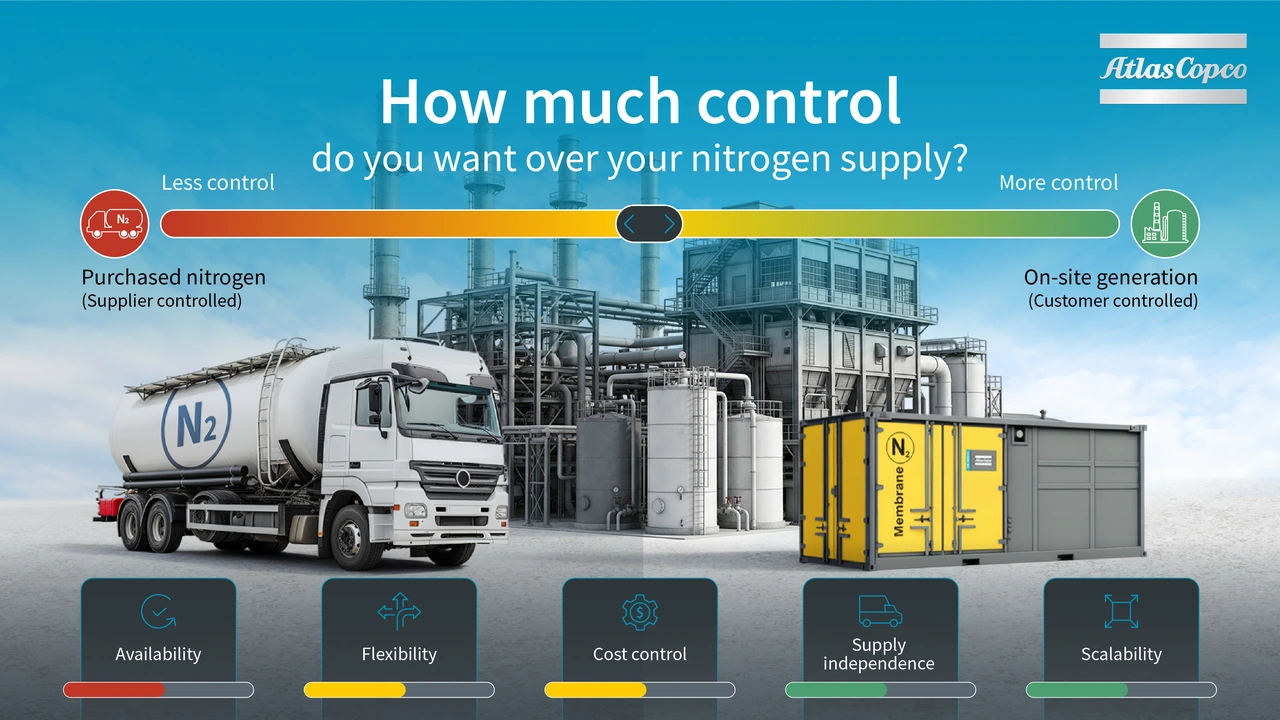
When comparing purchased nitrogen with on-site nitrogen generation, the difference ultimately comes down to control.
Purchased nitrogen means relying on deliveries, external suppliers and logistics networks. On-site nitrogen generation puts the supply directly in your hands, providing nitrogen whenever and wherever it is needed.